A Practical Problem–Solution–Buy Guide for Busy Cat Owners
If you've ever come home from work to find shredded paper on the floor, scratch marks on furniture, or a cat that suddenly wants to sprint laps around the house at midnight, you're not dealing with a "naughty" pet.
You're dealing with a bored one.
Indoor cats live longer, safer lives than outdoor cats—but they also miss out on the natural stimulation their brains and bodies evolved to expect. While you're away for 6–10 hours a day, your cat is left in an environment that rarely changes, offers little challenge, and doesn't allow them to express their hunting instincts.
The result is frustration, pent-up energy, and behaviors that often get misunderstood.
The good news? You can fix this completely by designing an environment that keeps your cat mentally and physically engaged—even while you're at work.
The Real Problem: Indoor Life Removes the "Hunt Cycle"
In nature, a cat's day revolves around a repeating pattern:
Hunt → Chase → Catch → Eat → Rest → Repeat
Indoor life removes almost all of that. Food appears instantly in a bowl. Nothing moves unless the owner is home. There's no challenge, no unpredictability, and no reward-driven activity.
When this cycle disappears, cats often develop:
-
Sleeping all day out of boredom is not needed
-
Sudden bursts of hyperactivity at night
-
Weight gain from inactivity
-
Attention-seeking or destructive behavior
-
Excessive meowing or pacing
-
Overgrooming caused by stress
Many owners try leaving out plush toys, but static toys don't feel like prey. Cats are triggered by movement, problem-solving, and reward, not decoration.
To keep a cat entertained while you're gone, you must recreate those missing elements artificially.
The Solution: Build an Automated Enrichment Environment
Think of it less as "buying toys" and more as designing a habitat.
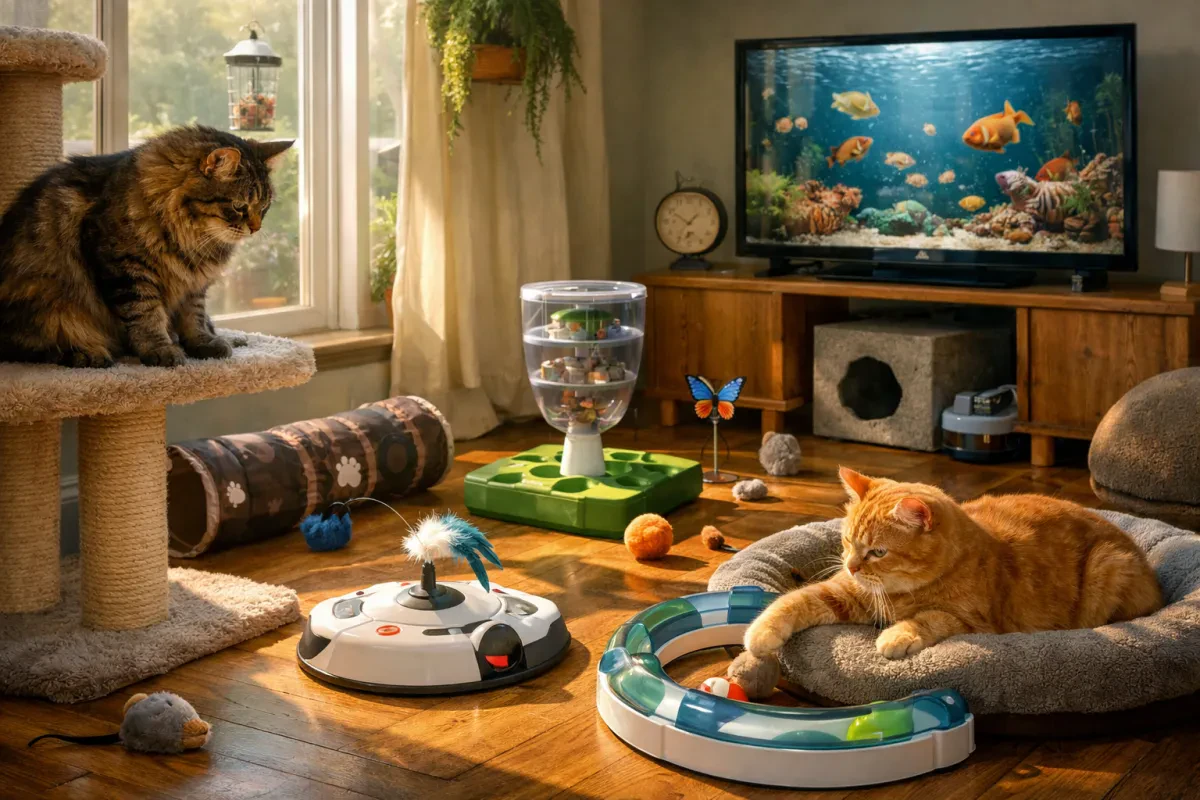
The most effective setups use three types of stimulation:
|
Natural Instinct |
Enrichment Tool |
|---|---|
|
Chasing movement |
Motion-activated rolling toys |
|
Stalking prey |
Automatic laser toys |
|
Working for food |
Puzzle feeders |
These tools allow your cat to engage in multiple mini "hunts" throughout the day without requiring your presence.
1. Motion-Activated Rolling Toys: Movement That Feels Alive
Cats are biologically programmed to respond to unpredictable motion. A toy that sits still gets ignored—but one that suddenly rolls, changes direction, or "escapes" instantly activates their prey drive.
Motion-activated toys switch on when touched or at timed intervals, creating short bursts of activity that mimic a small animal darting across the floor.
A popular example is the Interactive 2-in-1 Cat Toy, which moves unpredictably and reacts when batted, encouraging repeated chase sessions during the day. Many owners like to place it in an open space before leaving for work so their cat can re-engage with it multiple times.
Look for features like:
-
Randomized movement patterns
-
Rechargeable batteries (so it's always ready)
-
Auto shut-off cycles to prevent overstimulation
-
Durable outer shells for biting and kicking
These toys are especially helpful for cats who seem lazy but suddenly become active when something moves.
2. Automatic Laser Toys: Independent Stalking Practice
Laser play is incredibly effective because it stimulates a cat's stalking instinct. The unpredictable movement across floors and walls forces them to track, crouch, and pounce.
But handheld lasers only work when you're home.
Automatic laser devices, such as the YVE Life Laser Cat Toy project, rotate beams on a set schedule, allowing your cat to "hunt" throughout the day without human intervention.
This type of play engages your cat both mentally and physically. Instead of quick bursts, it encourages focused observation and calculated movement—exactly how real predators behave.
When choosing one:
-
Select models with timers or automatic cycling
-
Place them in clutter-free zones for safe chasing
-
Rotate usage so they stay novel
These work particularly well for cats that enjoy watching birds or shadows, as they mimic that same tracking behavior.
3. Puzzle Feeders: Turning Meals Into Mental Work
Food should never be completely effortless for an indoor cat.
In the wild, a cat might attempt dozens of hunts to secure enough calories. Eating from a bowl in 30 seconds eliminates that entire behavioral process, leaving them under-stimulated and often overeating.
Puzzle feeders restore the missing challenge.
Products like the Cat Treat Dispensing Toy require cats to paw kibble through different levels before it drops, turning feeding time into a slow, engaging activity.
Another option is the Interactive Cat Treat Puzzle, which introduces compartments that must be nudged and rotated to access food, adding variety and difficulty.
Benefits of puzzle feeding include:
-
Longer engagement while you're away
-
Slower, healthier eating
-
Reduced boredom-related weight gain
-
Mental stimulation tied to reward
Many owners replace one daily meal with a puzzle feeder to create a natural rhythm of effort followed by rest.
Creating a Daily Routine That Works Without You
You don't need to overwhelm your home with gadgets. A simple rotation creates all the stimulation your cat needs.
Morning (Before Leaving):
-
Fill a puzzle feeder with part of breakfast
-
Activate a rolling toy in the main living area
Midday (Automatic Play):
-
Laser toy runs for 10–15 minutes
-
Motion toy reactivates intermittently
Afternoon:
-
Cat alternates between resting and re-engaging
-
Puzzle feeder provides a continued challenge
By the time you return, your cat will have completed several mini activity cycles instead of sleeping all day.
Why Variety Matters More Than Quantity
Cats lose interest when stimulation is predictable. Rotating tools every few days keeps the environment fresh.
For example:
-
Monday–Wednesday: rolling toy + puzzle feeder
-
Thursday–Saturday: laser toy + different feeder
-
Sunday: interactive play with you
This mimics the changing conditions of a real territory.
Common Mistakes That Lead to "It Didn't Work"
Many enrichment tools fail—not because they're ineffective, but because they're used incorrectly.
Leaving everything out permanently
Novelty disappears quickly. Rotation is key.
Choosing noisy or repetitive toys
Cats ignore mechanical patterns that don't resemble prey.
Still feeding exclusively from bowls
Without effort tied to food, motivation drops.
Expecting instant results
Some cats need a few days to learn to use puzzle feeders or trust moving toys.
Patience and variety lead to lasting engagement.
The Buy Perspective: Enrichment Is Preventive Care
It's easy to think of automated toys as optional—but they actually prevent many problems that cost far more to address later.
Lack of stimulation contributes to:
-
Obesity-related health issues
-
Behavioral stress
-
Furniture destruction
-
Nighttime sleep disruption
-
Increased vet visits tied to inactivity
Investing in tools that replicate natural behavior is closer to environmental healthcare than entertainment.
If you're deciding where to start, begin with:
-
A motion-activated toy for physical activity
-
A puzzle feeder to extend mealtime engagement
-
An automatic laser for independent stimulation
This trio covers the full spectrum of hunting behavior.
The Result: A Calmer Home and a Happier Cat
When cats are given opportunities to chase, solve, and earn rewards during the day, their behavior changes dramatically.
Owners often notice:
-
Less nighttime hyperactivity
-
Reduced anxiety behaviors
-
Healthier weight maintenance
-
More relaxed evenings together
-
A cat that greets them calmly instead of frantically
Your cat doesn't need constant attention—but they do need an environment that respects their instincts.
By recreating the rhythm of the hunt with tools such as motion-activated rolling toys, automatic laser devices, and puzzle feeders, you transform long workdays into meaningful activity.
And that makes indoor life not just safe but also deeply satisfying for the animal sharing your home.